
San Diego, California – August 2026 — BOTE Optics is pleased to announce the successful conclusion of its first participation in SPIE Optics + Photonics, one of the leading international events for optics, photonics, imaging, sensing, and optical engineering.
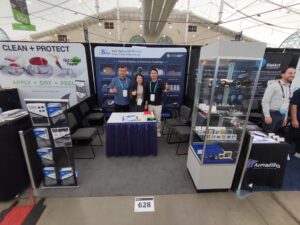
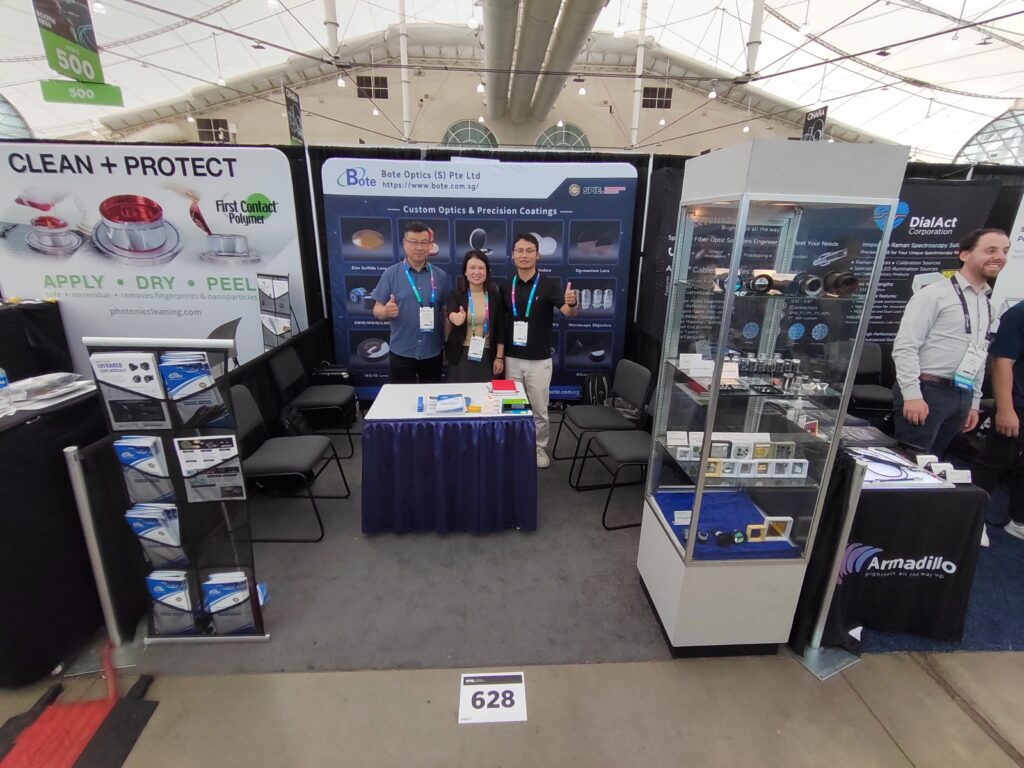
Held at the San Diego Convention Center in San Diego, California, the 2026 exhibition brought together researchers, optical engineers, scientists, OEMs, manufacturers, and technology companies from across the United States and around the world. BOTE Optics exhibited at Booth #628, where we presented our capabilities in infrared optical materials, precision infrared optics, custom IR lenses, optical polishing, optical coating, diamond turning, and complete infrared lens assembly.
For BOTE Optics, this exhibition was particularly significant because it was our first participation in SPIE Optics + Photonics. More importantly, the event provided valuable opportunities to meet directly with customers and technical professionals in the U.S. market and to better understand the sourcing, manufacturing, and engineering challenges currently facing the North American infrared optics industry.
The response from visitors was encouraging, particularly in two areas: the demand for reliable infrared optical materials, especially barium fluoride (BaF₂) and chalcogenide glass, and the growing interest in custom SWIR, MWIR, and LWIR imaging lenses.
These discussions have reinforced our belief that BOTE Optics can play an increasingly important role as a flexible and competitive optical manufacturing partner for customers in the United States and other international markets.
A First Appearance at SPIE Optics + Photonics
BOTE Optics has been manufacturing precision optical components and custom optical assemblies since 2005. Based in Singapore, the company combines optical design, precision manufacturing, diamond turning, CNC grinding and polishing, thin-film coating, inspection, and clean-room lens assembly within its manufacturing operation.
While BOTE has participated in major international photonics exhibitions in the past, SPIE Optics + Photonics 2026 marked our first appearance at this particular event.
The decision to participate was driven by the importance of the U.S. market for advanced optics and infrared imaging technologies.
The exhibition provided a unique opportunity to present BOTE’s capabilities directly to professionals working in areas including:
- Infrared imaging
- SWIR imaging
- MWIR imaging
- LWIR thermal imaging
- Aerospace optics
- Space optics
- Defense and security systems
- Scientific instruments
- Industrial inspection
- Remote sensing
- Spectroscopy
- Advanced optical sensors
- Research and development
Throughout the exhibition, our team had conversations with optical engineers, researchers, procurement professionals, system designers, and representatives from major U.S. technology organizations and research institutions.
The quality and technical depth of these discussions made our first SPIE Optics + Photonics exhibition a valuable experience for BOTE Optics.
Showcasing Our Infrared Optical Material and Manufacturing Capabilities
One of the main objectives of BOTE’s participation was to demonstrate that our capabilities extend beyond the supply of individual optical components.
We wanted visitors to understand that BOTE Optics can support a broader portion of the infrared optical manufacturing chain — from material sourcing and optical fabrication to polishing, coating, assembly, and testing.
At Booth #628, we showcased a range of infrared optical materials and finished components, including products based on:
- Germanium
- Silicon
- Zinc selenide (ZnSe)
- Zinc sulfide (ZnS)
- Chalcogenide glass
- Barium fluoride (BaF₂)
- Other infrared optical materials
These materials can be manufactured into a wide range of precision optical components, including:
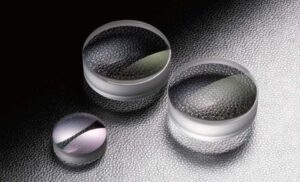
IR windows, infrared lenses, mirrors, aspheric lenses, prisms, filters, and other custom optical components.
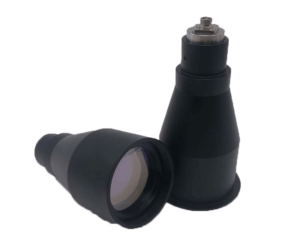
BOTE’s existing product capabilities include custom infrared lenses using materials such as Germanium, Silicon, ZnSe, and chalcogenide glass, together with customized optical coatings and precision manufacturing.
The exhibition allowed us to demonstrate not only the finished optics themselves, but also the manufacturing capabilities behind them.
From Raw Material to Finished Infrared Optics
A major advantage of BOTE Optics is our ability to control multiple stages of optical manufacturing within our own production environment.
For customers developing infrared systems, material selection is only the first step.
The optical material must then be processed to the required geometry, polished to the specified surface quality, inspected for dimensional and optical performance, coated according to the operating wavelength, and, in the case of an imaging lens, integrated into a mechanical housing and tested as a complete optical assembly.
BOTE Optics can support these stages through an integrated manufacturing workflow:
Material Sourcing → Precision Fabrication → Grinding & Polishing → Diamond Turning → Optical Coating → Inspection → Lens Assembly → Testing
This integrated model can provide significant advantages for customers developing customized infrared optical systems.
Instead of managing several different suppliers for materials, optical fabrication, coating, and assembly, customers can work with a single manufacturing partner capable of coordinating the complete process.
Our Singapore facility supports this approach, with BOTE’s public product information highlighting precision optical design, diamond turning, CNC grinding and polishing, thin-film coating, and clean-room lens assembly under its manufacturing system.
Strong Market Interest in Barium Fluoride and Chalcogenide Glass
One of the clearest messages we received during SPIE Optics + Photonics 2026 was the strong interest in infrared optical materials that have become challenging to source in the U.S. market.
Among these materials, barium fluoride (BaF₂) and chalcogenide glass generated particularly strong interest.
For optical engineers and procurement teams, material availability can have a direct impact on prototype development, optical qualification, production schedules, and overall project cost.
Barium fluoride is an important infrared optical material used in applications requiring broadband transmission and can be relevant to spectroscopy, sensing, imaging, and other infrared optical systems.
Chalcogenide glass is likewise attracting significant interest for infrared optical design, particularly for MWIR and LWIR imaging systems, where designers are looking for suitable materials that can provide the required optical performance while supporting compact and manufacturable lens designs.
At SPIE Optics + Photonics, several U.S. visitors specifically raised questions about the availability, quality, lead time, and cost of these materials.
This was particularly meaningful to BOTE because BaF₂ and chalcogenide glass are areas in which we have been actively developing our supply-chain and manufacturing capabilities.
The conversations confirmed that the challenge is not simply finding an optical material.
Customers are looking for a supplier that can provide:
- Consistent material quality
- Reliable supply
- Competitive pricing
- Reasonable lead times
- Precision fabrication
- Optical polishing
- Appropriate infrared coatings
- Engineering support
- Prototype quantities
- Production scalability
BOTE Optics aims to address these requirements through an integrated supply and manufacturing model.
Custom SWIR, MWIR and LWIR Infrared Lenses
Another major highlight of the exhibition was our SWIR, MWIR, and LWIR infrared lens solutions.
Visitors showed strong interest in our ability to develop customized infrared imaging lenses based on their specific application requirements.
Rather than limiting customers to standard off-the-shelf products, BOTE Optics can work with customers to develop custom infrared lens designs based on parameters such as:
- Operating wavelength
- Spectral band
- Focal length
- Field of view
- Aperture
- Detector format
- Image quality requirements
- Environmental conditions
- Mechanical envelope
- Coating requirements
- System integration requirements
Our infrared lens capabilities cover a range of applications and materials. BOTE’s published IR lens portfolio includes Germanium, Silicon, ZnSe, and chalcogenide glass, with customized AR, BBAR, and DLC coating options.
This capability is particularly valuable for customers who require an optical solution designed around a specific detector, sensor, or imaging platform.
SWIR Imaging Lenses for Emerging Applications
Short-wave infrared imaging is becoming increasingly important in industrial inspection, machine vision, semiconductor inspection, scientific instrumentation, agriculture, security, and other sensing applications.
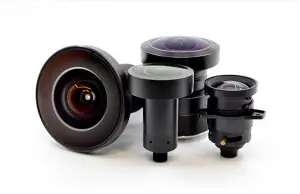
BOTE Optics has developed a product range that includes SWIR imaging lenses, fixed focal length lenses, wide-angle lenses, collimating lenses, and other imaging optics.
At the exhibition, discussions with customers demonstrated that SWIR applications increasingly require more than a basic lens.
Customers are looking for complete optical solutions that can be optimized around their sensors and system architecture.
BOTE’s ability to combine optical design, precision lens manufacturing, coating, mechanical integration, and testing provides a foundation for supporting these customized requirements.
MWIR and LWIR Optics for Thermal Imaging
MWIR and LWIR optics were another important part of our discussions in San Diego.
Thermal imaging systems place demanding requirements on infrared optical materials and coatings. Depending on the wavelength range and system architecture, designers may consider materials such as Germanium, ZnSe, ZnS, silicon, and chalcogenide glass.
BOTE Optics provides custom infrared lens manufacturing using several of these materials and offers coating options designed for different infrared wavelength bands. For example, BOTE’s Germanium lens capabilities include custom AR and DLC coatings for MWIR and LWIR applications.
For customers developing thermal cameras, infrared sensors, surveillance systems, industrial monitoring equipment, or scientific instruments, the ability to coordinate material selection, lens design, fabrication, coating, and assembly can significantly simplify the development process.
Precision Polishing and Optical Coating
An infrared optical component is only as effective as its finished surface and coating performance.
During the exhibition, we therefore placed significant emphasis on our capabilities in precision polishing and optical coating.
BOTE Optics manufactures a variety of precision optical components, including lenses, windows, mirrors, prisms, filters, and aspheric optics.
Depending on the material and application, components can be supplied with different optical coating solutions, including AR, BBAR, DLC, and other custom coatings.
For infrared applications, coating design must be considered together with the optical material and operating wavelength.
BOTE’s published capabilities include DLC and AR coatings for Germanium optics and custom IR filter coatings for applications across NIR and mid-infrared wavelength ranges.
This integrated approach allows our engineering team to consider the complete optical component rather than treating polishing and coating as independent processes.
Interest from U.S. Technology Companies and Research Institutions
One of the most encouraging aspects of SPIE Optics + Photonics 2026 was the diversity of visitors to the BOTE booth.
Our products and capabilities attracted interest from a number of U.S.-based companies, technology organizations, research laboratories, and academic professionals.
Among the visitors were representatives associated with SpaceX, researchers and professionals from well-known U.S. laboratories, and professors and PhD researchers from the University of Rochester’s optics community.
The conversations with these visitors were especially valuable because they allowed us to understand the requirements of both commercial and research-driven optical development.
For research laboratories and university groups, flexibility, customization, small-batch production, and technical communication are often critical.
For commercial customers, the priorities may include material availability, repeatability, quality control, cost, lead time, and the ability to transition from prototype to production.
BOTE Optics is positioned to support both types of requirements.
We would also like to emphasize that conversations at the exhibition represent potential business opportunities rather than completed customer relationships or confirmed projects. We are now following up with the organizations and professionals who expressed interest in our products and capabilities.
Why U.S. Customers Are Looking for Alternative Optical Supply Chains
The discussions in San Diego also highlighted a broader trend in the U.S. optical industry.
For many customers, sourcing strategy is becoming increasingly important.
A project may require an optical material that is available from only a limited number of suppliers, while prototype schedules and production requirements may demand greater flexibility than a traditional supply chain can provide.
This creates opportunities for qualified international optical manufacturers that can provide:
Quality + Availability + Engineering Support + Competitive Cost + Flexible Manufacturing
BOTE Optics believes that Singapore can serve as an effective manufacturing base for customers looking for an alternative Asian supply chain while maintaining strong engineering communication and international quality requirements.
Our goal is not simply to become another optical component supplier.
We aim to become a long-term manufacturing and engineering partner for customers who require customized infrared optics.
Our Next Step: Following Up With Customers After the Show
The conclusion of the exhibition marks the beginning of the next stage of our work.
Our first priority is to follow up with the customers and technical contacts who visited Booth #628.
Several visitors discussed specific requirements for infrared optical materials and components, and we are now working through these requests individually.
The initial follow-up process will focus on:
- Reviewing customer drawings and specifications
- Confirming material requirements
- Evaluating BaF₂ and chalcogenide glass requirements
- Reviewing SWIR/MWIR/LWIR lens designs
- Preparing technical proposals
- Providing samples where appropriate
- Evaluating prototype requirements
- Preparing quotations
- Confirming manufacturing lead times
- Supporting material and component qualification
For customers with urgent requirements, our engineering and sales teams will prioritize technical evaluation and quotation so that potential projects can move forward efficiently.
We believe that a successful exhibition is ultimately measured not by the number of visitors to a booth, but by the quality of the technical conversations and the long-term relationships that develop afterward.
Exploring a Stronger Local Presence in the United States
Our second major focus following SPIE Optics + Photonics 2026 is the possibility of establishing a BOTE Optics presence in the United States.
As our customer base in North America continues to develop, we recognize that some U.S. customers have specific requirements regarding local procurement, local communication, logistics, technical support, and supplier qualification.
For certain customers, having a U.S.-based BOTE Optics office or subsidiary could make the procurement process significantly more convenient.
We are therefore evaluating different options for establishing a BOTE Optics U.S. office, subsidiary, or other local operating presence.
The objective would not be to replace our Singapore manufacturing operation.
Instead, a U.S. presence could complement our Singapore factory by providing customers with closer access to:
- Local sales support
- Technical communication
- Project management
- Customer service
- Procurement coordination
- Local logistics
- Sample management
- After-sales support
The manufacturing strength of BOTE would continue to be supported by our Singapore facility, while a U.S. operation could provide greater proximity to our North American customers.
This potential expansion reflects our long-term commitment to the U.S. optical and photonics market.
Looking Ahead to SPIE Optics + Photonics 2027
Our first participation in SPIE Optics + Photonics 2026 has strengthened our interest in continuing to engage with the U.S. optics community.
We are therefore pleased to confirm that BOTE Optics plans to return to SPIE Optics + Photonics in 2027.
The 2027 event is scheduled to return to San Diego, with the exhibition scheduled for August 29–September 2, 2027.
By the time we return to San Diego, we hope to bring an even broader portfolio of infrared optical materials, precision components, custom IR lenses, and optical assemblies.
We also expect to have a deeper understanding of the requirements of our U.S. customers and potentially a stronger local support structure.
Our priorities for the coming year are clear:
First, strengthen customer relationships.
We will continue following up with the companies, laboratories, universities, and optical professionals we met at the 2026 exhibition.
Second, expand our infrared material supply capabilities.
BaF₂ and chalcogenide glass will remain important areas of focus as we continue to develop reliable and competitive sourcing solutions for international customers.
Third, develop more complete SWIR, MWIR, and LWIR optical solutions.
We will continue investing in custom infrared lens design, precision fabrication, polishing, coating, assembly, and testing.
Fourth, explore a stronger U.S. presence.
As our business in North America develops, we will evaluate the appropriate structure for local sales, technical support, logistics, and customer service.
From San Diego to the Next Stage of BOTE’s Global Expansion
Our first SPIE Optics + Photonics exhibition was more than an opportunity to display products.
It was an opportunity to listen.
We listened to optical engineers discussing material challenges.
We listened to researchers describing their next-generation imaging systems.
We listened to procurement professionals looking for more flexible sources.
And we listened to customers looking for suppliers capable of supporting customized infrared optics from material to finished assembly.
The feedback reinforced an important point: there is a real need for flexible, technically capable, and reliable infrared optics manufacturing partners in the international market.
BOTE Optics is ready to respond to that opportunity.
From barium fluoride and chalcogenide glass to Germanium, ZnSe, ZnS, and silicon, from IR windows and mirrors to precision lenses, aspheric lenses, prisms and filters, and from SWIR imaging lenses to MWIR and LWIR thermal imaging optics, we are continuing to build a broader and more integrated infrared optics platform.
Our Singapore manufacturing facility remains at the center of this capability, combining optical design, precision manufacturing, diamond turning, grinding and polishing, optical coating, inspection, and lens assembly.
At the same time, our growing engagement with the U.S. market is opening a new chapter for BOTE Optics.
We look forward to turning the conversations from Booth #628 into real engineering projects, long-term customer relationships, and new opportunities for cooperation.
Thank You, San Diego
Finally, we would like to sincerely thank everyone who visited BOTE Optics at Booth #628 during SPIE Optics + Photonics 2026.
Thank you to the optical engineers who shared their technical challenges, the researchers who discussed their projects, the procurement teams who asked about our infrared materials, and all of the companies and institutions that took the time to learn more about BOTE Optics.
We especially appreciate the interest in our BaF₂ and chalcogenide glass supply capabilities, as well as our SWIR, MWIR, and LWIR custom infrared lens solutions.
The exhibition may now be over, but our work with the U.S. optics community is just beginning.
If you are looking for a supplier of custom infrared optics, infrared optical materials, BaF₂, chalcogenide glass, Germanium optics, ZnSe optics, ZnS optics, SWIR lenses, MWIR lenses, LWIR lenses, IR aspheric lenses, DLC-coated optics, or precision optical components, we welcome the opportunity to discuss your requirements.
BOTE Optics – From Infrared Materials to Precision Optical Systems.
Thank you for meeting us in San Diego. We look forward to seeing you again at SPIE Optics + Photonics 2027.
Infrared Optics | Infrared Optical Materials | Barium Fluoride | BaF₂ Optics | Chalcogenide Glass | SWIR Lenses | MWIR Lenses | LWIR Lenses | Custom Infrared Lenses | Infrared Aspheric Lenses | Germanium Optics | ZnSe Optics | ZnS Optics | DLC Coating | Diamond Turning | Precision Optical Manufacturing | Optical Coating | IR Windows | IR Mirrors | IR Filters | SPIE Optics + Photonics | San Diego Optics Exhibition | U.S. Infrared Optics Supplier | Custom IR Optics
#SPIE #OpticsAndPhotonics #InfraredOptics #InfraredLenses #ChalcogenideGlass #BaF2 #BariumFluoride #SWIR #MWIR #LWIR #ThermalImaging #GermaniumOptics #ZnSe #ZnS #DLCcoating #DiamondTurning #PrecisionOptics #OpticalManufacturing #Photonics