
Mirrors and lenses are two essential optical components used to control the path of light. Although both can form images and direct light, they work in different ways. A mirror reflects light from its surface, while a lens refracts light as it passes through a transparent optical material.
Understanding the difference between a mirror and a lens is important when selecting optical components for cameras, telescopes, laser systems, thermal imaging devices, microscopes, and industrial inspection equipment.
In precision optics, the choice goes beyond reflection versus refraction. Optical designers must also consider wavelength, focal length, surface accuracy, optical coatings, material properties, and environmental conditions.
In this guide, we explain how mirrors and lenses work, compare their types and applications, and explore how to select the right optical components for your system.
1. Introduction to Mirrors and Traditional Lenses
Mirrors and lenses manipulate light to produce images, focus beams, or change the direction of light propagation. However, they achieve these results through different physical mechanisms.
A mirror uses reflection. When light strikes its reflective surface, it changes direction according to the law of reflection. The angle of reflection equals the angle of incidence.
A conventional optical lens uses refraction. When light passes between materials with different refractive indices, its direction changes. The curved surfaces and optical properties of the lens determine how the light converges or diverges.
Both components are widely used in consumer products and advanced optical systems. Mirrors are common in reflective telescopes and laser beam delivery systems, while lenses are essential in cameras, microscopes, imaging systems, and laser processing equipment.
In industrial optics, mirrors and lenses are often combined to achieve specific imaging or beam-control requirements.
2. What Is a Mirror? Understanding Reflective Optics
A mirror is an optical component with a surface designed to reflect light efficiently and predictably. Optical mirrors typically consist of a substrate and a reflective coating, although some designs use other reflective structures.
The substrate provides mechanical support and defines the optical surface. The reflective coating determines how much light is reflected at the intended wavelengths and angles of incidence.
How Do Mirrors Work?
Mirrors follow the law of reflection: the angle of incidence equals the angle of reflection, with both angles measured relative to the surface normal.
The mirror’s surface geometry determines how reflected rays behave.
- Plane mirrors: Reflect light without converging or diverging the rays from a distant point source.
- Concave mirrors: Can converge parallel incident rays toward a focal region.
- Convex mirrors: Cause parallel incident rays to diverge after reflection.
Concave mirrors can form real or virtual images, depending on the object’s position. Plane and convex mirrors form virtual images of real objects under ordinary viewing conditions.
Common Types of Optical Mirrors
Optical mirrors are available in several configurations:
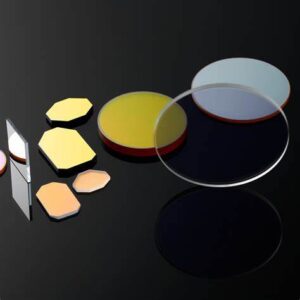
- Metallic mirrors: Use reflective metal coatings, such as aluminum, silver, or gold, selected according to the required wavelength range.
- Dielectric mirrors: Use multilayer thin-film coatings to provide high reflectance over a designed spectral range and angle of incidence.
- Spherical mirrors: Have spherical reflecting surfaces and are used in imaging and beam-control applications.
- Off-axis parabolic mirrors: Focus or collimate light without placing a central obstruction in the main optical path.
- Dichroic mirrors: Reflect selected wavelengths while transmitting others.
- Cold mirrors: Reflect selected spectral bands while transmitting much of the unwanted thermal radiation.
Each mirror type has different requirements for reflectance, surface figure, roughness, coating durability, and operating conditions.
For industrial applications, explore BOTE’s optical mirrors to learn more about precision reflective components.
3. What Is an Optical Lens?
An optical lens is a transparent component designed to control light through refraction. It is usually manufactured from optical glass, crystalline materials, infrared-transmitting materials, or optical polymers.
The lens geometry and refractive index determine how light rays change direction as they pass through the component.
How Do Optical Lenses Work?
When light crosses an interface between two materials with different refractive indices, its direction changes according to Snell’s law.
The curved surfaces of a lens control this change in direction and determine its optical power.
Two fundamental lens types are:
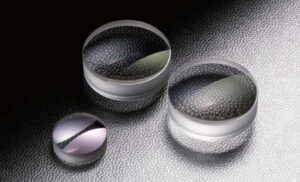
- Convex lenses: Generally converge parallel incident rays toward a focal point when used in air.
- Concave lenses: Generally diverge parallel incident rays when used in air.
A positive lens has positive optical power, while a negative lens has negative optical power. More complex systems combine multiple lens elements to control aberrations, improve image quality, and meet specific optical performance requirements.
Lenses can form real or virtual images depending on their design and the position of the object.
Common Lens Materials and Construction
The best lens material depends on the operating wavelength, transmission requirements, refractive index, thermal environment, and mechanical constraints.
Common materials include:
- Optical glass: Widely used for visible-light imaging and general optical applications.
- Fused silica: Offers useful transmission across selected ultraviolet, visible, and near-infrared ranges.
- Calcium fluoride (CaF₂): Used in applications requiring suitable transmission in ultraviolet or infrared spectral regions.
- Germanium (Ge): Commonly used in thermal imaging optics operating in appropriate infrared bands.
- Zinc selenide (ZnSe): Widely used in carbon dioxide laser optics and selected infrared applications.
- Silicon (Si): Used in infrared optical systems where its spectral transmission and other material properties are suitable.
- Chalcogenide glass: Used in selected infrared imaging and sensing applications.
Material selection must always be based on the actual operating wavelength and environmental conditions. No single material is suitable for every optical system.
BOTE provides custom optical components and lens solutions for visible, infrared, and other specialized optical applications. Explore BOTE’s precision optics for more information.
4. What Is a Mirror Lens? Definition and Working Principle
The term “mirror lens” can refer to different optical concepts, so it is important to distinguish them.
In general physics, a mirror and a lens are separate optical components that use reflection and refraction, respectively.
In optical engineering and photography, however, a mirror lens often refers to a catadioptric optical system. This design combines reflective and refractive elements to form an image.
How Do Mirror Lenses Work?
A catadioptric system typically uses a combination of curved mirrors and one or more refractive elements. Light follows a folded optical path, reflecting between surfaces before reaching the image plane.
This configuration can provide a long effective focal length in a relatively compact package. It is used in certain telescopes, compact telephoto lenses, and specialized optical instruments.
Mirror lenses are not necessarily better than conventional refractive lenses. Their performance depends on the optical prescription, alignment, aperture, wavelength, and application requirements.
In industrial optical engineering, the phrase can also be used informally to describe systems containing both mirrors and lenses. Technical specifications should identify the actual optical configuration rather than relying on the term alone.
5. Fundamental Differences Between Mirrors and Lenses
The most important difference between a mirror and a lens is how each component interacts with light.
| Comparison | Optical Mirror | Refractive Lens |
|---|---|---|
| Primary mechanism | Reflection | Refraction |
| Light path | Light returns from the reflecting surface | Light passes through the optical material |
| Main structure | Substrate and reflective surface or coating | Transparent optical material with shaped surfaces |
| Focusing method | Curvature of the reflecting surface | Surface geometry and refractive index |
| Common configurations | Plane, concave, convex, parabolic | Convex, concave, aspheric, cylindrical |
| Transmission through the component | Usually not the intended function of an opaque mirror | Essential to normal lens operation |
| Coating requirements | Reflective coatings are often essential | Antireflection or other functional coatings may be used |
| Typical applications | Reflective telescopes, beam steering, laser systems | Cameras, microscopes, imaging and focusing systems |
| Common performance concerns | Reflectance, surface figure, coating durability | Transmission, aberrations, refractive index, surface figure |
Mirror vs. Lens: Which Produces Better Images?
Neither component is universally superior.
A mirror can avoid the chromatic aberration associated with refraction because reflection does not depend on wavelength in the same way. However, mirrors can still exhibit geometric aberrations, coating-related losses, and wavelength-dependent reflectance.
A conventional lens can deliver excellent imaging performance, but its refractive properties can cause chromatic aberration unless the design and material selection control it.
The best solution depends on the wavelength range, field of view, aperture, image quality, system size, and cost targets.
6. Types of Mirrors Compared with Traditional Lens Types
Different mirror and lens designs address different optical requirements.
| Optical Type | Key Characteristics | Common Applications |
|---|---|---|
| Plane mirror | Flat reflecting surface | Beam steering, alignment |
| Concave mirror | Converging reflection for suitable geometries | Reflective imaging, light collection |
| Convex mirror | Diverging reflection | Wide-field viewing and specialized optical systems |
| Parabolic mirror | Can focus or collimate on-axis parallel rays with reduced spherical aberration | Telescopes, laser systems |
| Plano-convex lens | One flat surface and one convex surface | Focusing and imaging |
| Plano-concave lens | One flat surface and one concave surface | Beam expansion and divergence control |
| Biconvex lens | Two convex surfaces | Imaging and light collection |
| Biconcave lens | Two concave surfaces | Beam divergence and optical power adjustment |
| Aspheric lens | At least one aspheric surface | Aberration correction and compact optical systems |
| Catadioptric system | Combines reflective and refractive elements | Telescopes and selected compact imaging systems |
The correct design should be selected based on ray-path requirements, optical performance, mechanical integration, and manufacturing feasibility.
7. Applications of Mirrors and Traditional Lenses
Mirrors and lenses support a wide range of scientific and industrial technologies.
Applications of Optical Mirrors
Laser systems: Mirrors direct, fold, and control laser beams. Coating reflectance, laser-induced damage threshold, and surface quality are important selection criteria.
Astronomical telescopes: Reflective optics collect light from distant objects. Large mirrors can offer practical advantages over large refractive objectives.
Industrial inspection: Mirrors redirect optical paths in machine vision and inspection equipment where space or packaging constraints matter.
Infrared sensing: Reflective components can be used in infrared optical systems when their substrate and coating are appropriate for the operating band.
Applications of Optical Lenses
Machine vision: Imaging lenses capture and focus light onto cameras used for automated inspection, measurement, and quality control.
Medical equipment: Microscope objectives and imaging lenses support observation, diagnostic imaging, and precision instruments.
Laser processing: Focusing lenses concentrate laser energy onto a target. Material compatibility, focal length, coating performance, and laser power must be considered.
Thermal imaging: Infrared lenses made from suitable materials, such as germanium or zinc selenide, can transmit thermal radiation within their intended operating bands.
Scientific instruments: Lenses control magnification, numerical aperture, focal position, and image quality in measurement and research systems.
BOTE supports precision optical applications with custom lenses, mirrors, coatings, and optical assemblies. Learn more about custom optical solutions.
8. Advantages of Mirrors Over Traditional Lenses
Mirrors offer several benefits in applications where reflection is the preferred optical mechanism.
Reduced Chromatic Aberration
Reflection does not produce chromatic aberration in the same manner as refraction. This makes reflective optics useful in broadband imaging and selected multiwavelength systems.
However, the mirror coating must still provide adequate reflectance across the required spectral range.
Potentially Compact Folded Optical Paths
Mirrors can redirect light through a folded optical path, allowing designers to package long optical paths into a smaller enclosure.
Advantages for Large-Aperture Systems
Large reflective optics can be practical because a mirror does not need to transmit light through its entire bulk. This can reduce some of the material and fabrication challenges associated with large refractive elements.
Flexible Spectral Design
Metallic and dielectric coatings can be designed for specific wavelength ranges. With the appropriate substrate and coating, mirrors can support visible, near-infrared, mid-wave infrared, or other selected spectral applications.
The actual performance depends on coating design, angle of incidence, polarization, substrate properties, and operating conditions.
9. Limitations and Disadvantages of Mirrors
Mirrors also introduce engineering challenges.
- Coating sensitivity: Reflective coatings can be affected by contamination, oxidation, moisture, handling, or operating conditions, depending on the coating material.
- Alignment requirements: Some reflective systems require precise angular and positional alignment.
- Obscuration in certain designs: Secondary mirrors can block part of the incoming light in some telescope and imaging configurations.
- Surface accuracy: High-performance applications may require tight surface-figure and surface-roughness specifications.
- Spectral limitations: No coating provides ideal reflectance at every wavelength, angle, and polarization.
For demanding optical applications, mirror selection should consider the complete optical specification rather than reflectance alone.
10. Advantages and Disadvantages of Traditional Refractive Lenses
Refractive lenses are widely used because they provide direct and versatile control over image formation.
Advantages of Refractive Lenses
- Versatile imaging: Lens groups can support magnification, focusing, zooming, and image formation.
- Flexible optical design: Multiple elements can be combined to correct aberrations and meet complex imaging requirements.
- Broad application range: Lenses are used in cameras, microscopes, laser systems, medical devices, and industrial imaging.
- Compact integration: Lens assemblies can be designed to fit specific mechanical housings and optical layouts.
- Material selection: Different optical glasses and infrared materials support different wavelength ranges and environmental conditions.
Disadvantages of Refractive Lenses
- Chromatic aberration: Different wavelengths can refract by different amounts, requiring suitable optical designs to control color-related errors.
- Transmission losses: Some light can be reflected at each surface or absorbed within the material.
- Material constraints: Transmission, thermal properties, refractive index, and mechanical behavior vary among materials.
- Fabrication complexity: Precision lenses may require tight control of surface form, centering, thickness, and surface quality.
- Thermal sensitivity: Temperature changes can affect refractive index, dimensions, and focus.
Appropriate optical coatings, material choices, and system-level design can reduce many of these limitations.
11. Mirror Lenses vs. Refractive Lenses: Cost Comparison
The cost of a mirror or lens depends on more than the component type.
Important cost drivers include material availability, aperture, surface geometry, tolerances, coating requirements, inspection standards, production volume, and assembly complexity.
| Cost Factor | Mirrors | Refractive Lenses |
|---|---|---|
| Material cost | Depends on substrate, size, and material availability | Depends on glass type, crystal, or specialty optical material |
| Surface fabrication | Depends on surface figure, geometry, and finish | Depends on surface geometry, centration, and finish |
| Coating | Reflective coating may be required | Antireflection or functional coating may be required |
| Assembly | May require precise alignment and mounting | May require centering, spacing, and lens-group alignment |
| Inspection | Reflectance, surface figure, and roughness may be critical | Transmission, surface figure, centration, and imaging performance may be critical |
| Overall cost | Application-dependent | Application-dependent |
A simple mirror may cost less than a complex lens assembly, but a large, high-precision parabolic mirror with a specialized coating can be expensive.
Likewise, a standard spherical lens may be economical, while a custom aspheric infrared lens with tight tolerances may require substantial engineering and manufacturing effort.
For OEM projects, the best comparison is based on the total cost of the optical system, including manufacturing, coatings, assembly, inspection, and expected service life.
12. Key Factors to Consider When Choosing Mirrors vs. Lenses
Before specifying an optical component, evaluate the following parameters.
1. Operating Wavelength
Determine whether the system operates in the ultraviolet, visible, near-infrared, short-wave infrared (SWIR), mid-wave infrared (MWIR), or long-wave infrared (LWIR).
The substrate and coating must be compatible with the required spectral range.
2. Optical Performance
Define the required focal length, aperture, field of view, wavefront error, surface figure, surface roughness, and image quality.
For imaging systems, additional parameters may include modulation transfer function (MTF), distortion, and chromatic correction.
3. Environmental Conditions
Consider operating temperature, humidity, vibration, contamination, and exposure to chemicals or high-power laser radiation.
Environmental requirements can influence substrate selection, coating design, mounting, and protective measures.
4. Mechanical and Packaging Constraints
Evaluate component diameter, thickness, mass, mounting interfaces, alignment access, and available space.
Mirrors can help fold an optical path, while lens groups can provide compact imaging solutions when properly designed.
5. Manufacturing and Inspection Requirements
For custom optics, specify tolerances and acceptance criteria before production.
Relevant requirements may include surface irregularity, surface roughness, centration, coating performance, and optical testing documentation.
6. Total Project Cost
Consider prototype development, tooling, production volume, inspection, lead time, and long-term repeatability.
Working with an optical manufacturer early in the design process can help balance optical performance with manufacturability and cost.
13. Case Studies and Real-World Examples
The following examples illustrate typical engineering decisions. They are representative scenarios, not claims about specific customer projects.
Case Study 1: Laser Beam Delivery
An industrial laser system needs to redirect a high-power beam through a compact mechanical enclosure.
Potential solution: A suitably coated optical mirror can redirect the beam without requiring it to pass through a refractive substrate.
Key considerations: Wavelength, angle of incidence, polarization, surface quality, coating reflectance, and laser-induced damage threshold.
A focusing lens may still be required at the processing head. The mirror and lens perform complementary functions.
Case Study 2: Thermal Imaging Camera
A thermal imaging system must collect infrared radiation from an object and form an image on a detector.
Potential solution: An infrared lens made from a suitable material, such as germanium or zinc selenide, may be selected according to the operating wavelength and system requirements.
Key considerations: Spectral transmission, focal length, aperture, temperature range, coating performance, and image quality.
Reflective optics may also be considered where the system architecture and packaging requirements support them.
Case Study 3: Scientific Optical Instrument
A research instrument must focus light while maintaining image quality across a specified wavelength range.
Potential solution: A refractive lens group may be suitable when compact imaging and aberration correction are priorities. A reflective or catadioptric design may be preferable when broadband performance or a folded optical path is more important.
Key considerations: Wavelength range, numerical aperture, optical alignment, aberrations, thermal stability, and measurement accuracy.
These examples show why the correct component depends on the complete optical design rather than a general rule that mirrors or lenses are always better.
14. How BOTE Supports Precision Optical Applications
BOTE Optics (S) Pte Ltd is a Singapore-based optical manufacturer established in 2005. The company provides precision optical components, custom lenses, optical coatings, and optical system solutions for industrial and scientific applications.
Its capabilities include optical design, precision machining, grinding and polishing, thin-film coating, metrology, and lens assembly.
Depending on project requirements, BOTE can support applications involving:
- Precision optical mirrors and reflectors
- Spherical and aspheric lenses
- Germanium, silicon, and zinc selenide optics
- Infrared imaging components
- Optical coatings and custom optical assemblies
- Prototype development and volume production
For engineers and procurement teams, integrating material selection, optical fabrication, coating, and inspection within a coordinated manufacturing process can help simplify supplier management and support consistent component quality.
To discuss a custom requirement, visit BOTE Optics or explore its precision optical components and optical mirror solutions.
15. Frequently Asked Questions About Mirrors and Lenses
What is the main difference between a mirror and a lens?
A mirror reflects light from its surface, while a lens refracts light as it passes through a transparent optical material. Both can form images and control light, but they use different physical mechanisms.
Can a mirror focus light?
Yes. A concave or parabolic mirror can focus suitable incident rays toward a focal point or focal region. The result depends on the mirror’s geometry and the incoming light.
Can a lens reflect light?
A lens can reflect some light at its surfaces, but its primary optical function is refraction. Optical coatings can reduce unwanted reflection or provide other wavelength-selective functions.
Which is better for a telescope: a mirror or a lens?
Neither is universally better. Reflecting telescopes can offer practical advantages for large apertures and avoid refractive chromatic aberration. Refracting telescopes can provide excellent image quality with appropriate optical design. The choice depends on aperture, wavelength, image quality, size, and cost.
What is a mirror lens in photography?
A mirror lens commonly refers to a catadioptric lens that combines mirrors and refractive elements. It can provide a long effective focal length in a compact optical package, although its imaging characteristics differ from those of conventional telephoto lenses.
Are infrared mirrors and lenses made from the same materials?
Not necessarily. Infrared optical components require materials and coatings selected for their operating wavelength. Germanium, silicon, zinc selenide, and chalcogenide glass are used in selected infrared lens applications, while mirror substrates and coatings depend on the optical design and spectral requirements.
Which is more expensive, a mirror or a lens?
The answer depends on material, size, geometry, tolerances, coatings, production volume, and inspection requirements. A simple component may be economical, while a custom high-precision mirror or lens assembly can require substantial engineering and manufacturing effort.
How do I choose a mirror or lens for an industrial optical system?
Start with the operating wavelength, optical function, focal length, aperture, required image or beam quality, environmental conditions, mechanical constraints, and budget. An optical engineer can then evaluate the appropriate component type and design.
Conclusion: Mirror or Lens—Which One Should You Choose?
The difference between a mirror and a lens comes down to how each component controls light. Mirrors use reflection, while refractive lenses use refraction. Both are essential in modern optical engineering, and each offers distinct benefits and limitations.
Mirrors are useful for beam steering, reflective imaging, and selected broadband optical systems. Lenses are well suited to focusing, imaging, magnification, and complex optical assemblies.
For industrial applications, the final choice should be based on wavelength, optical performance, material properties, coating requirements, mechanical integration, and total system cost.
BOTE Optics supports precision optical projects with custom mirrors, lenses, infrared components, coatings, and optical manufacturing solutions. Selecting the right component begins with defining the system requirements and matching them to an appropriate optical design.
Need a custom optical solution? Contact BOTE Optics to discuss your application’s wavelength range, optical specifications, and manufacturing requirements.